
Introduction #
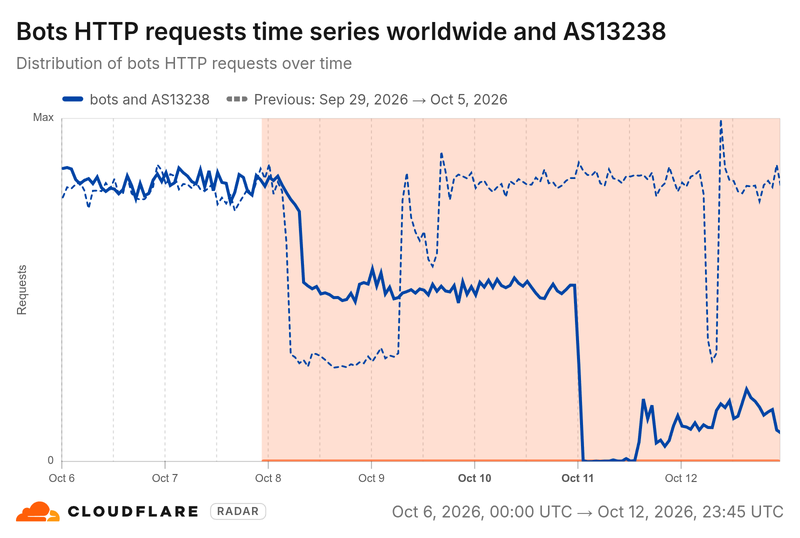
Ukraine struck three of Yandex’s five data centres from 8 October. Within days a Cloudflare chart was circulating as proof that Russian bot networks had gone dark, and President Zelensky1 credited the strikes with “less hate, less division and fewer provocations” online.
What the line measures #
The collapse is real. What it measures is the problem: Cloudflare counts every automated HTTP request reaching its network, overwhelmingly search crawlers rather than accounts posting opinions. It told BBC Verify1 the drop was “not necessarily bot behaviour on social media platforms”.
Mikhail Klimarev, an independent analyst, told BBC Russian1 that Yandex uses bots to “essentially crawl the entire internet once a day”, and most likely switched them off as its computing capacity degraded. A search engine with three of its five data centres hit stops crawling. That is the whole shape of the graph.
What didn’t change #
dTeam1, which tracks Moscow-linked influence operations, saw “no traffic change from known Russian accounts and bot clusters on any platform”. The claim travelled anyway, and a post by Czech MEP Tomáš Zdechovský2 reached 4.2 million views.
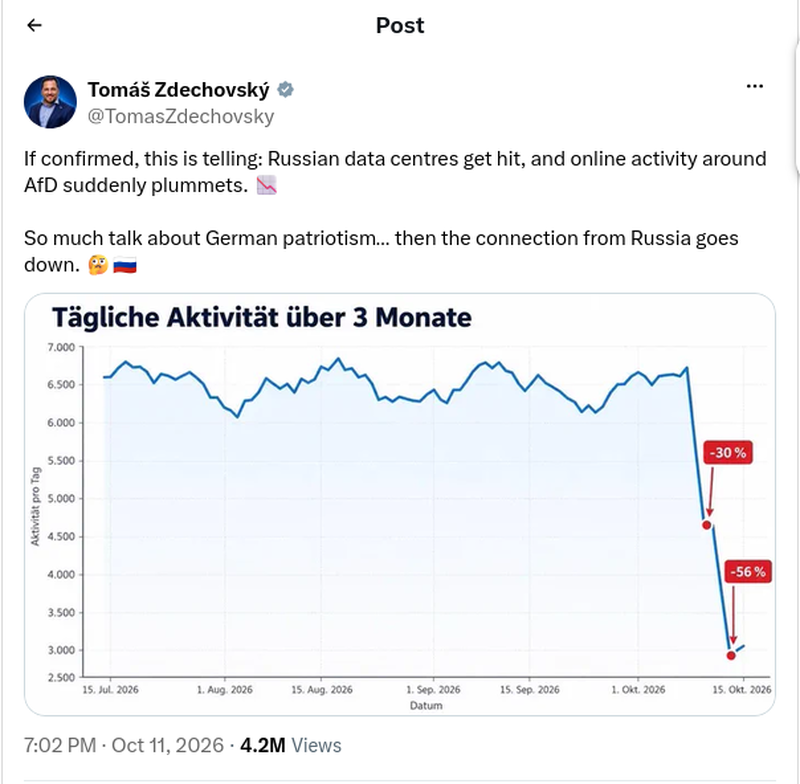
Its chart names no source and never says what “activity” counts. The post that started the argument about Cloudflare’s data does not contain Cloudflare’s data. Zdechovský has since said1 he “did not present it as a clear fact”.
Who got it wrong #
Not the press: BBC Verify, Maldita and Mother Jones3 took the claim apart within days. The conflation came from politicians, and from our own feeds. Kevin Beaumont4 was blunt:
People confuse legit search engine bots with social media bots. Russian propaganda operations don’t run from Yandex. They never have.
Eva Galperin5 drew the lesson: “every one of us could be fooled by a story that we really want to be true”.
A crawler stopped crawling. Everything else was what we wanted it to mean.
-
BBC Verify, “Is Zelensky right to say data centre strikes have taken down Russian bots?”, 13 October 2026. https://www.bbc.com/news/articles/c9y7l0pm8jkko ↩︎ ↩︎ ↩︎ ↩︎ ↩︎
-
Tomáš Zdechovský (@TomasZdechovsky) on X, 11 October 2026. https://x.com/TomasZdechovsky/status/2109328777452962127 ↩︎
-
Ground News, “Yandex drones hit Russian Google — suddenly it gets quieter in social media.” https://ground.news/article/yandex-drones-hit-russian-google-suddenly-it-gets-quieter-in-social-media ↩︎
-
Kevin Beaumont (@GossiTheDog), Cyberplace, 13 October 2026. https://cyberplace.social/@GossiTheDog/117435047238592484 ↩︎
-
Eva Galperin (@evacide), Hachyderm, 13 October 2026. https://hachyderm.io/@evacide/117434963703286230 ↩︎